 |
| Can we join in too?! Teacher Dorkas is leading a Circle Time song that gets everyone up and moving! |
From Amari in Mufindi:Mufindi Orphans has not only expanded its Children’s Village, but also the scope and depth of other projects! The goal of these Educational programs is to work within the existing educational framework to create sustainable options and pathways for all children. There is an understanding that national education standards cannot be changed, but students and teachers can be empowered to use available resources and think outside of the box! For teachers, Mufindi Orphans and its partners provide a Kindergarten Village Outreach Program, and for students, we work in three sectors: Early Childhood Education, Vulnerable Youth Sponsorship and Support, and Vocational Schooling. This blog will focus on the early childhood education provided on-site to the Vulnerable Children under the care of Igoda Children’s Village, as well as local youth.
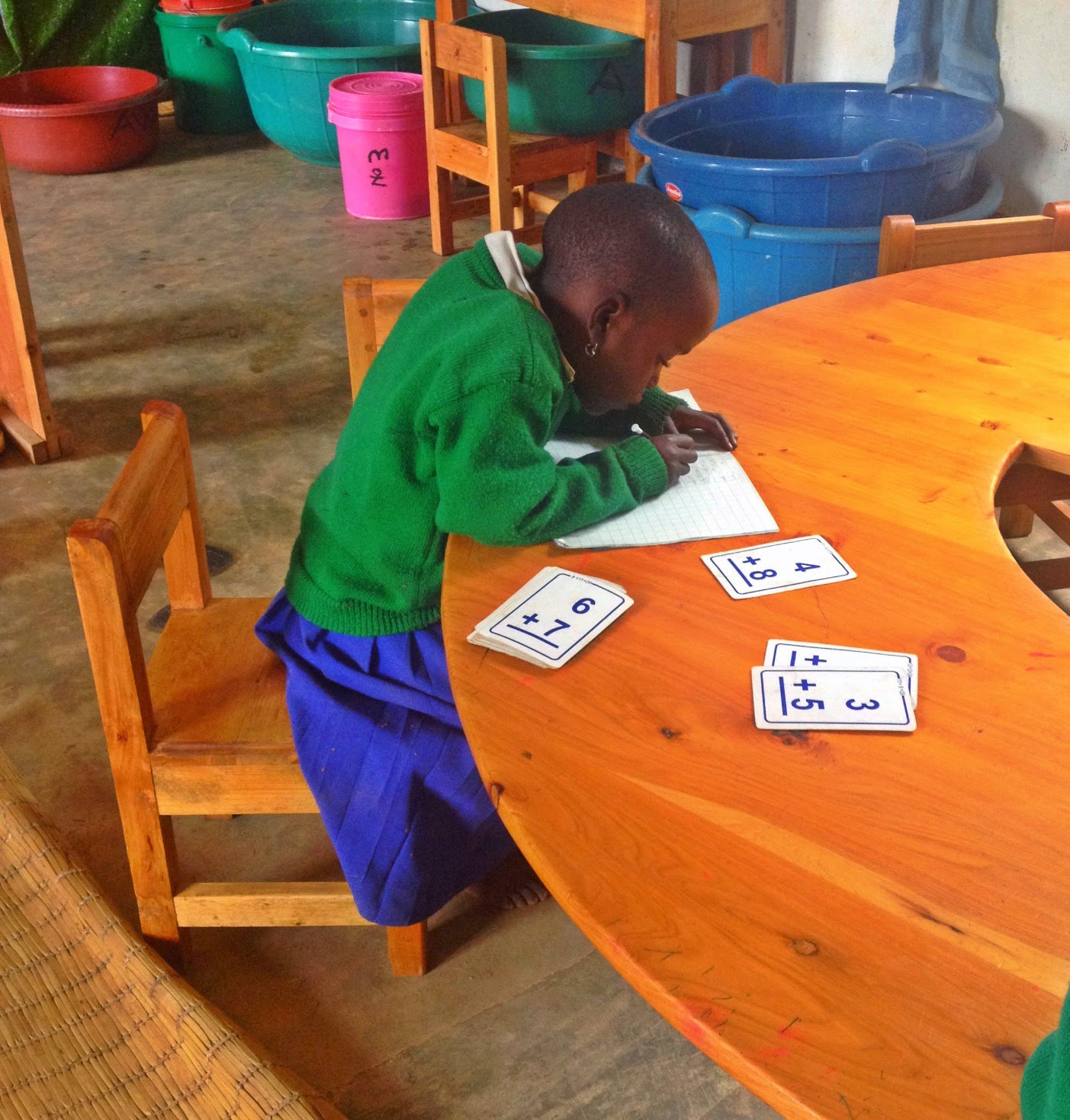 |
Igoda Village student Anita practices her addition! She is top
of her class in math and the independent learning style of the
classroom allows her to move at her own pace- and she sure flies! |
Welcome to the Interactive Learning Pre-school and Kindergarten! Mufindi Orphans- through a partnership with the Olive Branch for Children in Mbeya, Tanzania - has taken Western educational philosophy, tweaked it, and developed a culturally sensitive model for rural village schools with little government support. Mufindi Orphans has both on-site classrooms, as well as a Kindergarten Village Outreach Program - which will be highlighted in a later blog!
There are currently two pre-school classes (ages 8 months to 1.5 years and 1.5 years to 3 years) and two Kindergarten classes (ages 3 years to 8 years) on-site. The teaching style is based on the Montessori-philosophy of child-directed learning. This means that the teacher follows the child's interest and pace through the engagement of self-correcting, independent activities. School curriculum uses culturally appropriate, independent activities that are organized into Montessori’s Five Sections of the Classroom: Practical Life, Sensorial, Math, Language, and Culture and Science. Each child is free to move from one activity to another based upon their interests. The teacher’s role is to observe and guide.
 |
James is a little boy with a killer smile. Unfortunately, he
also has a back deformity that makes getting up and around difficult.
This classroom is a perfect place for him because he is able to be
supported in a chair at an appropriate level and engage in activities
that hold his interest!
|
Each day is broken up into two periods of independent activity and three short Circle Times. The day begins with a Circle Time where the children and teachers greet each other, talk about the day, and do a fun song or game. The following two Circle Times are also filled with songs, dancing, games, and activities that allow the children to release energy but in a structured way. The children often take turns leading the songs, and it is not uncommon to hear both English and Swahili songs being used. In fact, Circle Time is usually the first place an English word or greeting is introduced, tied to a song or game. It is a goal of the school to integrate English and Swahili completely.
 |
Even snack time is an activity that is used to teach
independence! Students enjoy their snack independently at a table set
for four. As one student finishes another takes her place without
prompting from the teacher. Students love to treat it as a mini
"restaurant" and enjoy their break time just like the rest of us!
|
This “new” approach to early childhood education is an important departure from more strict teaching methods commonly seen in over-crowded classrooms. This method has ultimately been more effective in this rural setting for a number of reasons. First, this methodology has been proven effective in high volume classrooms and little resources. This means that in most Kindergarten classrooms in the village, books, furniture, desks, and shelving are all anomalies. About 90% of the on-site classroom activities and materials are hand-crafted by teachers, setting the example that one doesn’t need money to teach. All that is needed is a little ingenuity, resourcefulness, and dedication to the job at hand. Second, the independent activity approach to teaching means that students can work together in small groups that are overseen and guided by the teacher. No longer is one teacher attempting to control and gain the attention of 100 five year olds (a common ratio in village classrooms). Finally, a classic Montessori classroom contains children of a wide age range- as do classrooms in the village. The child-directed philosophy allows each child the freedom to move at their own pace, regardless of the level of their fellow peers. Teachers then have the freedom to provide more advanced students with harder and harder activities to prepare them for Primary School, while younger children can refine their motor skills and practice culturally appropriate skills they can use at home!
 |
Boni is a sweet boy with Fetal Alcohol Syndrome who thrives in
the Interactive Learning Kindergarten. Boni loves the Practical Life
activities of the classroom that encourages him to refine his motor
skills and perfect life skills that sometimes don't come as easy to
him. He just needs a little bit more time to do things himself and
this environment gives him just that! |
The vulnerable youth at the Children's Village thrive under the structure and routine that the classroom provides. They are allowed freedom to explore and engage their interests with tangible, reinforced limits. This, as well as the individualized attention, means that development is monitored more closely than ever and troubled behavior can be addressed quickly. Teachers are able to work closely with guardians to reinforce discipline and send cohesive messages to the children. Also, the teachers are very familiar with the children and the medical problems each child may face so they can give them the best care and report any changes in health status quickly and efficiently. It is the hope of Mufindi Orphans to one day be able to provide on-site schooling for all children who face medical problems that might prevent them from thriving in local schools.
 |
To promote peace education and community building, at
the end of every school day, each child receives a high-five, a hug,
and a kiss on the cheek from every other student and teacher! It is a
great way to support a loving classroom environment and the kids love
to show their affection for their friends this way!
|


